Two Opposite Failure Modes in Conservation Scores
Evolutionary conservation scores are routinely treated as intrinsic properties of an amino acid position, yet the same residue can receive opposite calls depending on gap handling and comparator selection. In our new preprint from MIT, Alper Karagöl and I characterize two opposite failure modes in standard alignment-based scores and show that both can be computed directly from the alignment before scoring begins.
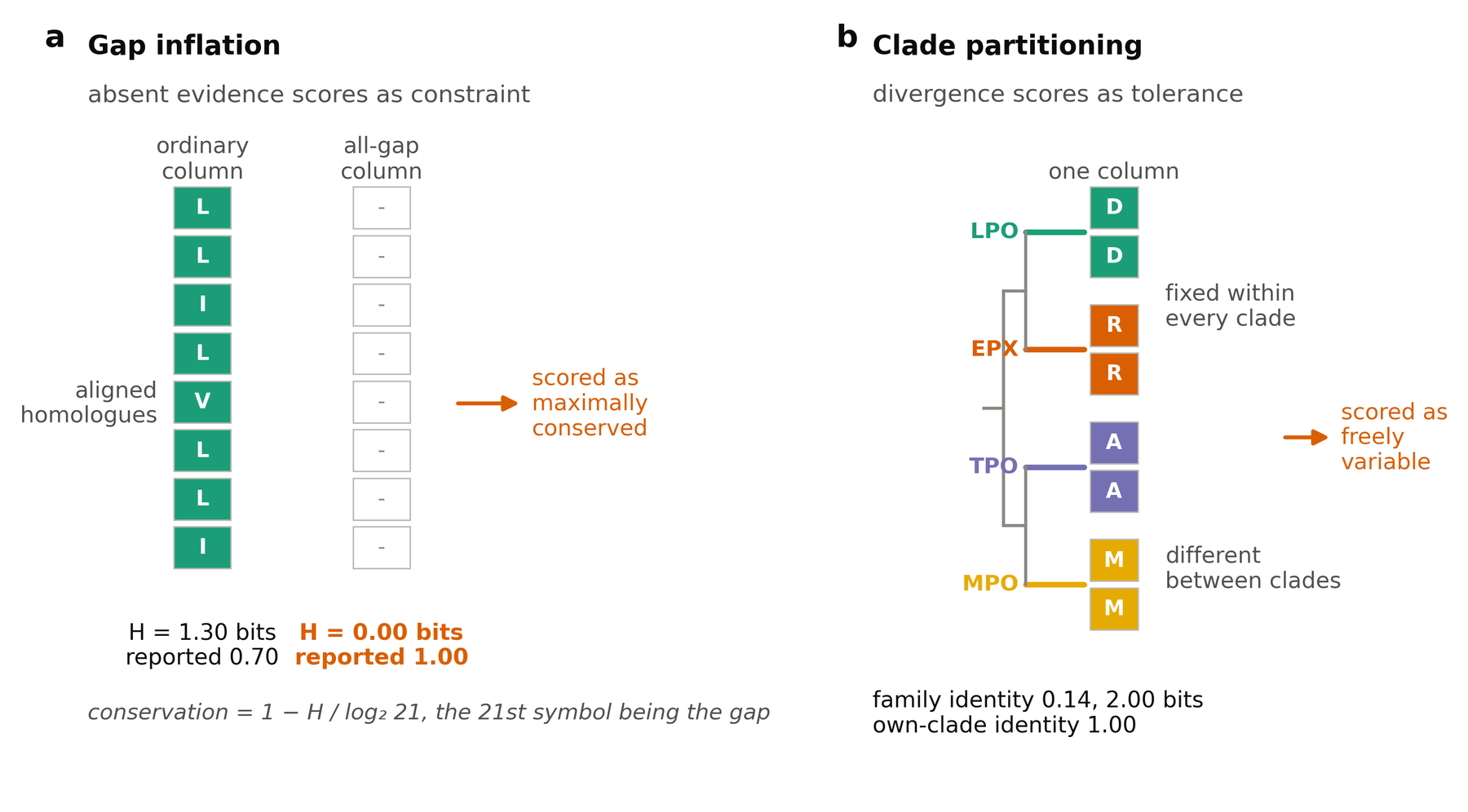
When conservation is calculated over a 21-symbol alphabet that treats the gap character as a twenty-first residue, an all-gap column scores as maximally conserved by construction. Across 55,816 alignment columns, reported conservation rises with column gap fraction at r = +0.553, dropping to +0.066 once recomputed over ungapped residues alone. Recomputing without gap inflation strengthens agreement with AlphaMissense from 0.416 to 0.551 and raises human pathogenic-versus-benign discrimination of a published rigid-conserved score from AUC 0.832 to 0.919.
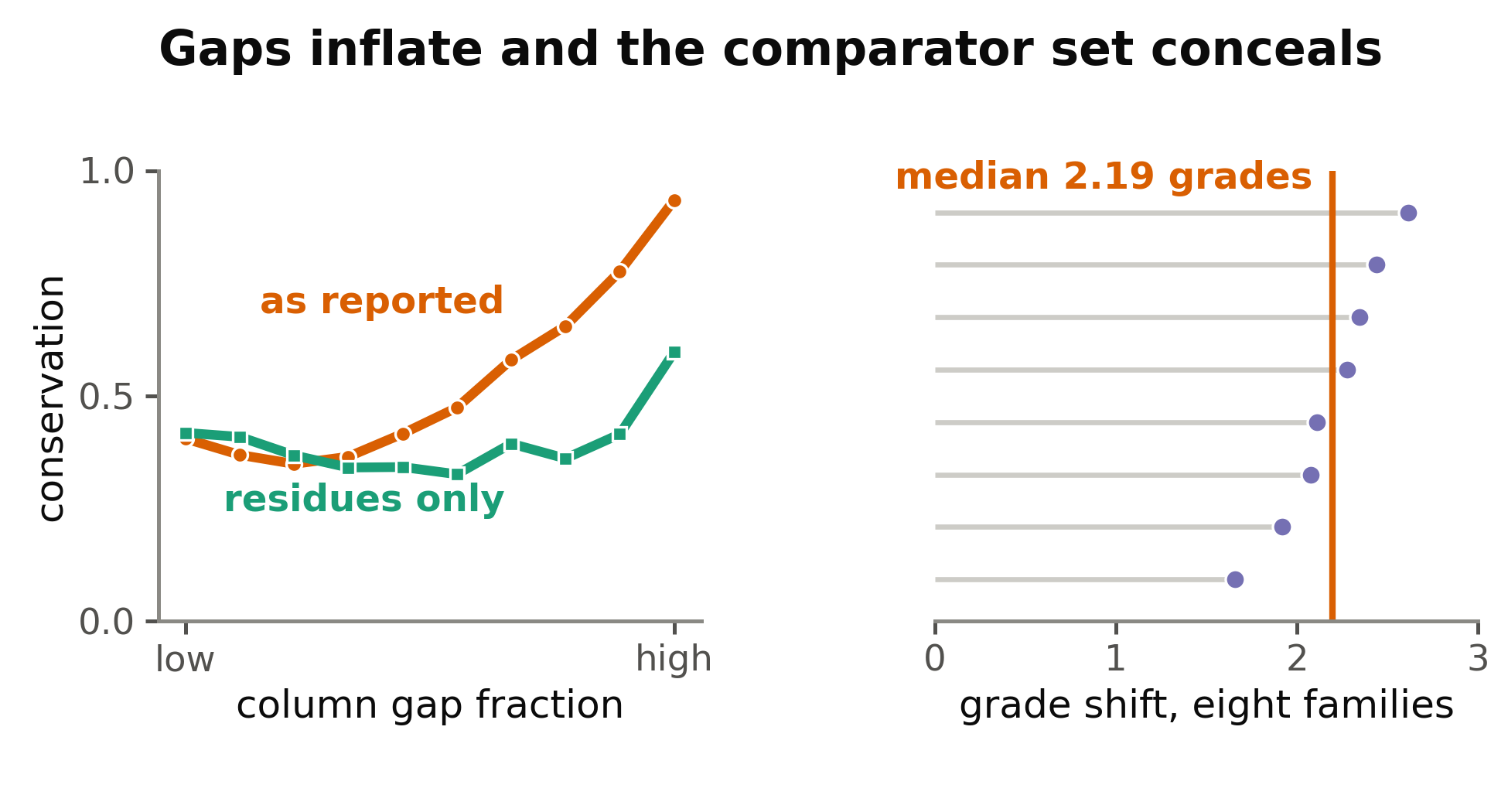
In the opposite direction, pooling divergent paralogues into a single alignment reads between-subfamily fixation as mutational tolerance. Varying only the comparator set across 5,092 positions in eight protein families shifts positions by a per-family median of 2.19 grades on a nine-grade scale and flips a median of 6.6 percent of residues from variable to conserved, while human variants matching a sister subfamily's fixed state are benign-enriched at an odds ratio of 2.46. We packaged the per-position diagnostics into GapCheck, a client-side browser tool available on this site alongside the full open-source repository.
bioRxiv: https://doi.org/10.64898/2026.10.20.760363
GapCheck Web Tool: https://www.tanerkaragol.com/gapcheck
Code & Diagnostics (GitHub): https://github.com/karagol-taner/conservation-score-reliability
Karagöl, T., Karagöl, A. Two opposite failure modes in alignment-based conservation scores, one inflating and one concealing constraint, are computable before the score is used. bioRxiv (2026). https://doi.org/10.64898/2026.10.20.760363