Two-Step Substitution Routes
Out of the 380 ordered amino-acid exchanges in the standard genetic code, 230 require two or three nucleotide changes, forcing evolution and protein design to pass through a stepping-stone residue one base change from each end. Standard deep mutational scans mutate a single starting protein and measure only the first step, yet whenever the same protein has been scanned from two different starting sequences, pairing the two deposits completes the two-step bridge.
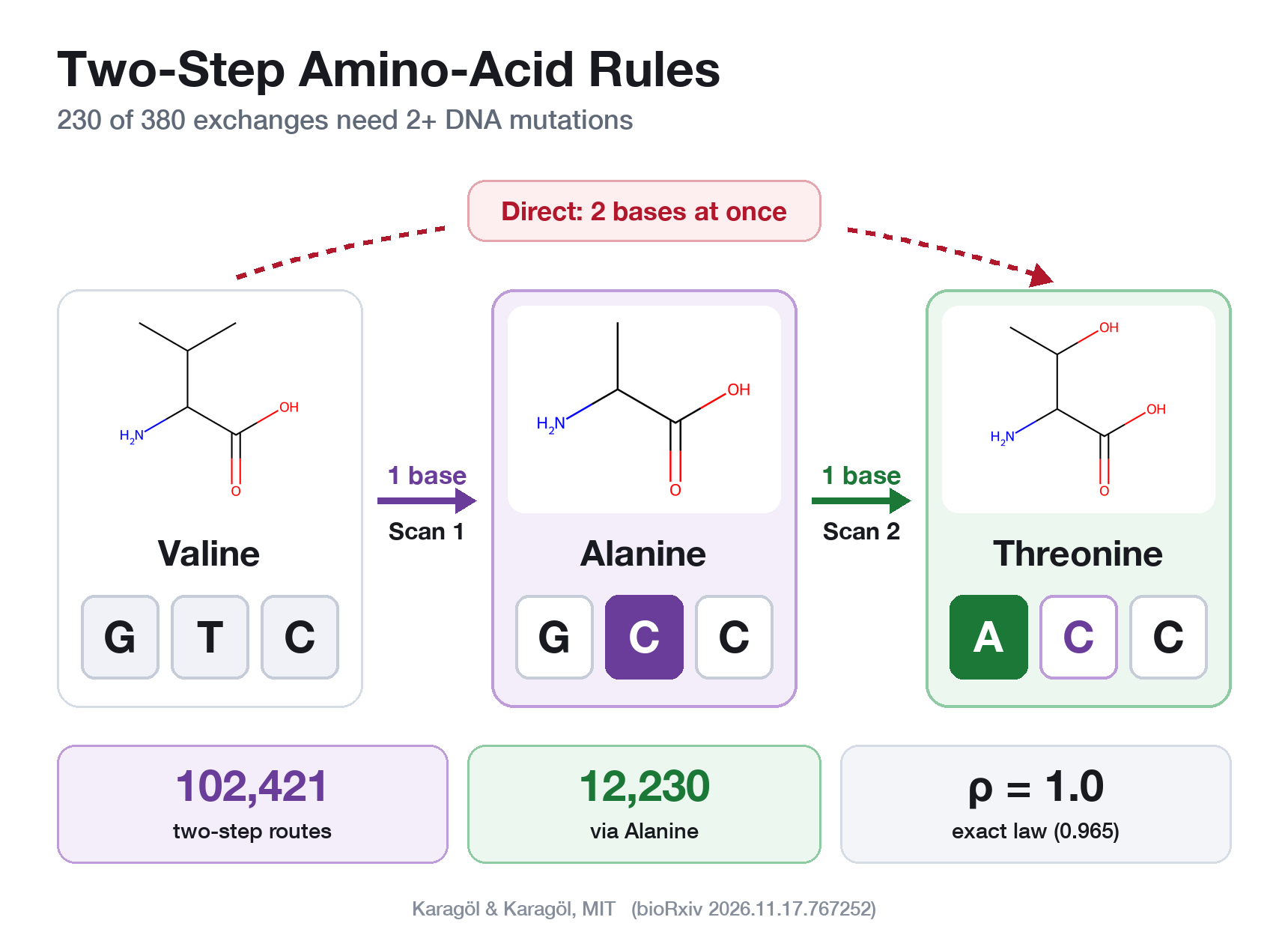
In our new preprint from MIT, Alper Karagöl and I assembled 102,421 complete two-step routes across 65 protein clusters in MaveDB, including 15,478 single-base bridges across two-base barriers and 12,230 routes passing through alanine. To verify when two experiments can be combined, we derived a parameter-free algebraic test requiring a rank correlation of 1.0 wherever two starting sequences differ only at the mutated site, returning a median of 0.965 across 741 qualifying pairs in 46 proteins.
Comparing shared sites across independent scans of the same protein also establishes a median agreement of 0.642, placing an experimental ceiling of 0.80 at a random position on variant-effect predictors benchmarked against a single scan. All analysis scripts, the one-correlation audit, and the complete route census are openly available on GitHub alongside the bioRxiv preprint.
bioRxiv: https://doi.org/10.64898/2026.11.17.767252
Code & Census (GitHub): https://github.com/karagol-taner/two-step-substitution-routes
Karagöl, T., Karagöl, A. Most substitutions need more than one base change and an exact test tells which deposited scans measure the route. bioRxiv (2026). https://doi.org/10.64898/2026.11.17.767252