top of page



Awarded the EAN Grant for Our Presentations in Neurology Conference
Supported by the EAN Conference Grant, we attended the 11th European Academy of Neurology Annual Congress in Helsinki to present our research on the structural dynamics of central nervous system transporters. Our first presentation mapped the specific cross-reactivity between the glial excitatory amino acid transporter 1 (EAAT1) and truncated EAAT2 isoforms. We defined the mechanisms by which these truncated isoforms function as selective interface blockers, expanding the und
7 days ago1 min read


How Solvent Environments Shape Immune Receptors: Insights from TLR5
How do immune receptors adapt to function in entirely different physical spaces? Toll-like Receptor 5 plays a crucial role in recognizing bacterial pathogens, typically operating as a membrane-bound sentinel. However, certain teleost fish, such as the orange-spotted grouper (Epinephelus coioides), possess an intriguing evolutionary workaround. They express both traditional membrane-bound forms and uniquely soluble forms of this receptor. We released a study detailing a compar
May 101 min read


Milan ESHG 2025: Genomic and Structural Insights into Hemophilia B
We have attended the 2025 European Human Genetics Conference (ESHG) in Milan, Italy, to share our approaches to studying Hemophilia B. The ESHG annual meeting is one of the most significant global gatherings for human genetics and genomics, making it an ideal venue to discuss our specific investigations into Coagulation Factor 9. These projects represent a collaborative effort at University College London (UCL), we gave two presentations detailing different analytical perspec
May 101 min read


Water-Soluble Olfactory Receptors: AlphaFold3 and Molecular Dynamics Analysis
How exactly do we perceive scent at the molecular level? Despite being one of our most fundamental senses, the mechanics of olfaction remain largely a mystery. The main obstacle is that olfactory receptors are locked tight inside cell membranes, making them notoriously difficult to isolate and study in a laboratory setting. In our recent structural bioinformatic study published in QRB Discovery, we addressed this challenge directly by engineering these vital proteins to exist
May 91 min read


Two Awards in Korea for Neurobiology Research
We received two separate International Fellowship grants from TÜBİTAK, the national scientific council of Türkiye, during the KSBNS Annual Meeting in Gyeongju, South Korea in 2024. These awards are highly competitive and recognize researchers who bring impactful scientific findings to the global community. The work focused on the regulatory architecture of glutamate transporters. We presented research on truncated isoforms, showing how these shorter protein variants act as in
May 91 min read


How Alternative Splicing Disrupts Glutamate Transporter Assembly
In 2024, our team published a comprehensive study in Pharmaceutical Research detailing the inhibitory effects of truncated isoforms on glutamate transporter oligomerization. This research investigates how alternative mRNA splicing generates shortened protein variants that function as intrinsic negative regulators within the central nervous system. Glutamate transporters are essential for maintaining proper neurotransmitter balance, and their physiological activity relies on s
May 91 min read


Engineering the Neurotransmitter Transporters: Glutamate and Serotonin
Our foundational research on the structural bioinformatics of glutamate and monoamine transporters established the core methodology we use to bypass the membrane barrier. These publications detail the application of the QTY code to engineer water soluble variants of these critical neurotransmitter transporters. By systematically replacing hydrophobic amino acids with structurally similar hydrophilic residues, we demonstrated that the proteins can become soluble while preservi
May 91 min read


Directional Variant Tension (Tv) - Decoding Hidden Constraints in Protein Adaptation
https://communities.springernature.com/videos/directional-variant-tension-tv-decoding-hidden-constraints-in-protein-adaptation Standard models assume mutations flow equally in both directions. In reality, proteins face strict structural bottlenecks. Discover how Directional Variant Tension (T v) exposes these hidden constraints to resolve the pathogenicity paradox and accelerate protein engineering.
May 71 min read
Finding the Goldilocks Zone in Your Proteins!
In astronomy, the Goldilocks Zone is that perfect, habitable distance from a star: not too hot, not too cold, but just right for life to exist. In our latest research, we discovered that proteins have a Biophysical Goldilocks Zone too, and it changes how we understand disease mechanisms. For years, we assumed that if a part of a protein was evolutionarily conserved, it had to be a stable, immovable anchor. But this binary view misses the most sophisticated machinery of the ce
Feb 61 min read


Beyond Static Conservation: A Hands-On Guide to Dynamics-Aware Evolutionary Profiling with ADEPT
If you've ever used a conservation score to interpret a missense variant, you've quietly accepted a tradeoff: traditional conservation metrics treat every residue the same way, regardless of whether it sits in a rigid hydrophobic core or a flexible loop that moves through nanometers of space during catalysis. That's a problem. Because those two kinds of residues fail for completely different biophysical reasons when you mutate them, and modern pathogenicity predictors, can bl
Feb 25 min read


Molecular Mechanics Poisson-Boltzmann Surface Area on Cloud Computing
Following our widely explored repository “ 𝗠𝗼𝗹𝗲𝗰𝘂𝗹𝗮𝗿 𝗗𝘆𝗻𝗮𝗺𝗶𝗰𝘀 𝗼𝗻 𝗖𝗹𝗼𝘂𝗱 𝗖𝗼𝗺𝗽𝘂𝘁𝗶𝗻𝗴 ” and its pre-print, we’re introducing a workflow designed for Google Colab and HPC/Jupyter systems (environments without a GUI) to run GMX_MMPBSA ( 𝙈𝙤𝙡𝙚𝙘𝙪𝙡𝙖𝙧 𝙈𝙚𝙘𝙝𝙖𝙣𝙞𝙘𝙨 𝙋𝙤𝙞𝙨𝙨𝙤𝙣–𝘽𝙤𝙡𝙩𝙯𝙢𝙖𝙣𝙣 𝙎𝙪𝙧𝙛𝙖𝙘𝙚 𝘼𝙧𝙚𝙖 )! Molecular dynamics (MD) simulations help us see how biological molecules behave in motion, revealing mechanisms behind
Oct 18, 20251 min read


When Half a Protein Is Enough!
In the world of membrane proteins, truncated isoforms have long been treated as evolutionary leftovers - partial gene products that don’t quite “make the cut”. In many studies, they are filtered out of analyses as unstable, nonfunctional, or even nuisances. We too once viewed them this way. For this interesting behind the paper story, you can check our article in Springer Nature: https://go.nature.com/483kVvV
Oct 18, 20251 min read


What Do Membrane Proteins Really Want? (Behind the Paper)
To check our interesting behind the paper story, please visit: https://go.nature.com/3KnbhdB
Oct 18, 20251 min read


Turning Ideas Into Patents: Lessons Learned & Challenges
Many people assume that innovation in medicine must start within the walls of a university. However, my experience has been quite the...
Feb 12, 20251 min read


Biology meets economics: game theory and medicine
Biology and economics are often viewed as separate domains, but they share a surprising connection on principles like game theory and...
Jan 3, 20252 min read


The Science Side of London
During my long stay in London, I discovered a thriving science scene that might not be immediately apparent to everyone. This city, known for its rich history and vibrant culture, also offers a wealth of opportunities for scientific exploration and intellectual growth. The city's scientific institutions and events play a crucial role in promoting a culture where curiosity, inquiry, and free thinking are cherished. One of my first stops was the Royal Society, a place steeped i
Jul 10, 20241 min read
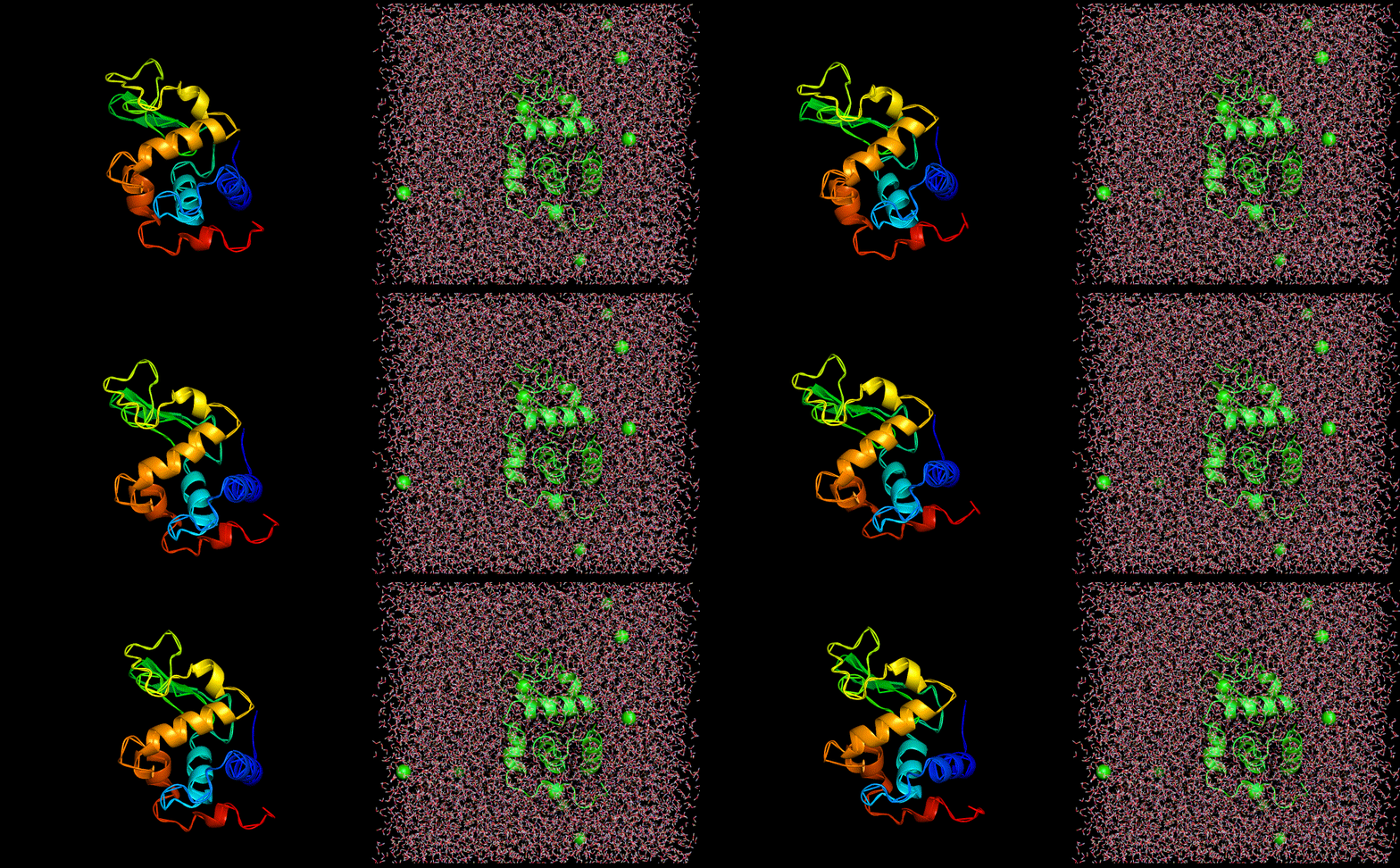
Molecular Dynamics on Google Compute Engine, AWS (Amazon Web Services), and other Cloud Computing services
New Update: This project is now accompanied by a published paper on bioRxiv, which benchmarks molecular dynamics simulations across various cloud platforms, with a special focus on optimizing Google Colab for scientific computing: https://www.biorxiv.org/content/10.1101/2024.11.14.623563v1 Update: This post has reached more than 700 views! Molecular dynamics (MD) simulations are a powerful computational tool used in various fields of science, including chemistry, biology, and
Feb 29, 20242 min read


HGVS Missense Variants to FASTA format Converter
Are you a researcher working with protein sequences? If so, you know the importance of accurately studying the effects of missense...
Feb 23, 20242 min read
Decoding Genomic Language: Polymorphism, Mutation, and Variant
The term "mutation" was used for either a generic alteration or, more specifically, a change with disease implications. Also, the term "polymorphism" was used to explain those genetic alterations occurring at a frequency of 1% or higher. However, this dual usage has led to confusion and misinterpretation across various disciplines. To solve this problem, a shift away from the terms "mutation" and "polymorphism" has been adopted. Instead, a preference is given to using neutr
Jan 2, 20241 min read
bottom of page